
Storm-Proofing Your Garage Door Before Nashville's Fall Wind Events
A typical call after a windstorm starts the same way: the homeowner says the door 'just popped open' or 'bowed in the middle' during the night. On inspection, the tracks are usually pulled slightly away from the wall, one or two panels are flexed or cracked, and the opener has been straining against a door that's no longer moving smoothly. Sometimes the whole door has come off its tracks entirely. None of this happens because the door was old or poorly made. It happens because garage doors are, by design, the largest moving opening in the exterior wall of a house — and when wind hits a home, that opening is where the pressure finds its weak point.
Why the Garage Door Is a Home's Weakest Wall
Most exterior walls are solid, braced, and tied into the structure. A garage door is a large panel of lightweight material, hinged in sections, held in place mostly by its tracks and rollers rather than a rigid frame. When high wind hits the front of a house, it creates positive pressure pushing in and, at the same time, negative pressure trying to suck the roof up. If the garage door fails and blows in, that sudden pressure change can put stress on the roof structure itself. This is why a failed garage door is treated as a serious structural event, not just an inconvenience — once the door goes, wind and rain get a direct path into the house.
What Makes a Door More Vulnerable
- Age and wear: Rollers and hinges that are worn let panels flex more than they should under pressure.
- Track alignment: Tracks that have drifted even slightly out of plumb give wind a starting point to push the door off its rails.
- Panel material: Thin, non-reinforced panels bow more easily than doors built with internal bracing.
- Opener strain: An opener fighting a door that's already struggling to move smoothly can fail at the worst possible moment, leaving the door unsecured.
Why This Matters Now
Middle Tennessee gets a real mix of severe weather through the fall and into winter — fast-moving fronts with heavy rain and gusty wind, the occasional remnants of Gulf storm systems pushing inland, and later in the season, ice storms that add weight and strain to door hardware. Garages here also deal with constant humidity and moisture from pine cover and shaded yards, which speeds up corrosion on tracks, hinges, and springs. A door that's been quietly rusting or sagging through a humid summer is exactly the kind of door that fails during the first serious wind event of the season.
Pre-Storm Inspection Checklist
Before the next front comes through, walk through these checks. Most take fifteen minutes and don't require tools.
- Tracks: Look for gaps between the track and the wall bracket. Tracks should be firmly anchored with no visible play.
- Rollers and hinges: Spin each roller by hand. Grinding, flat spots, or heavy resistance mean it's time for replacement before it becomes a failure point under load.
- Panels: Press gently on the center of each panel. Noticeable flex or any existing dents and cracks are weak spots wind will find first.
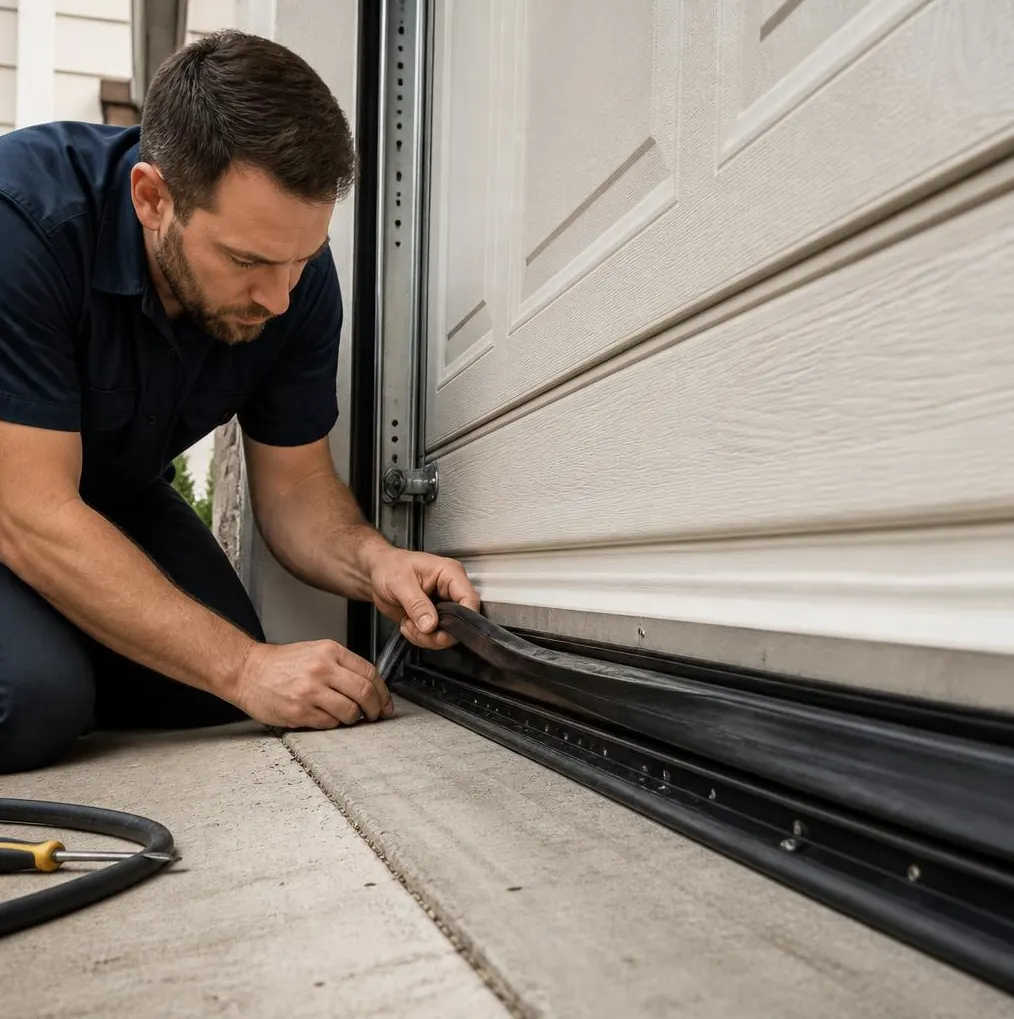
- Weatherstripping: Worn seals along the bottom and sides let wind-driven rain in, even on a door that otherwise holds up fine.
- Springs: A door that feels heavy or uneven when opened by hand likely has a spring under extra strain — exactly the kind of component that can snap during a storm when the door is working harder than normal.
- Opener backup: If your opener has battery backup, test it. Power outages are common during severe weather, and a dead backup means a door stuck in whatever position it was in when the power cut out.
Reinforcing the Door Itself
For homeowners who've had a door fail once, or who simply want more protection going into storm season, there are a few practical upgrades worth the trade-off:
- Horizontal bracing kits: Retrofit braces run across the back of the panels and tie into the tracks, adding rigidity to an existing door without full replacement. This is usually the lower-cost option.
- Wind-rated replacement doors: Built with reinforced panels and stronger track systems from the start. More expensive upfront, but it's the most reliable long-term fix if the current door is older or already showing wear.
- Auto-reverse and sensor checks: Not storm-specific, but a door with working safety sensors is also a door whose opener is functioning correctly under normal conditions — which matters when it's suddenly asked to perform under wind load.
After the Storm
Once the weather clears, don't just assume the door is fine because it's still closed. Open and close it manually if possible, listening for grinding or uneven movement. Check that it travels straight on both tracks rather than drifting to one side. Look over the panels again for new dents or hairline cracks, and check that the opener engages smoothly without hesitation or excessive noise. Any of these signs mean something shifted during the storm, even if the door never actually failed.
When to Call Nashville Garage Door Service
If a storm has already left your door off-track, a spring has snapped under the added strain, or the opener won't engage after a power outage, that's not a wait-and-see situation — it's a call for emergency garage door service. Our technicians also handle spring repair and replacement and pre-storm inspections for homeowners who want their door checked and reinforced before the next front moves through, so a bad forecast doesn't turn into a bad night.
If you're in Nashville, Brentwood, Franklin, Hendersonville, Mount Juliet, Murfreesboro, Smyrna, or Gallatin and want your garage door ready for whatever this season brings, call Nashville Garage Door Service today. We show up on time, diagnose it honestly, and fix it right the first time.